
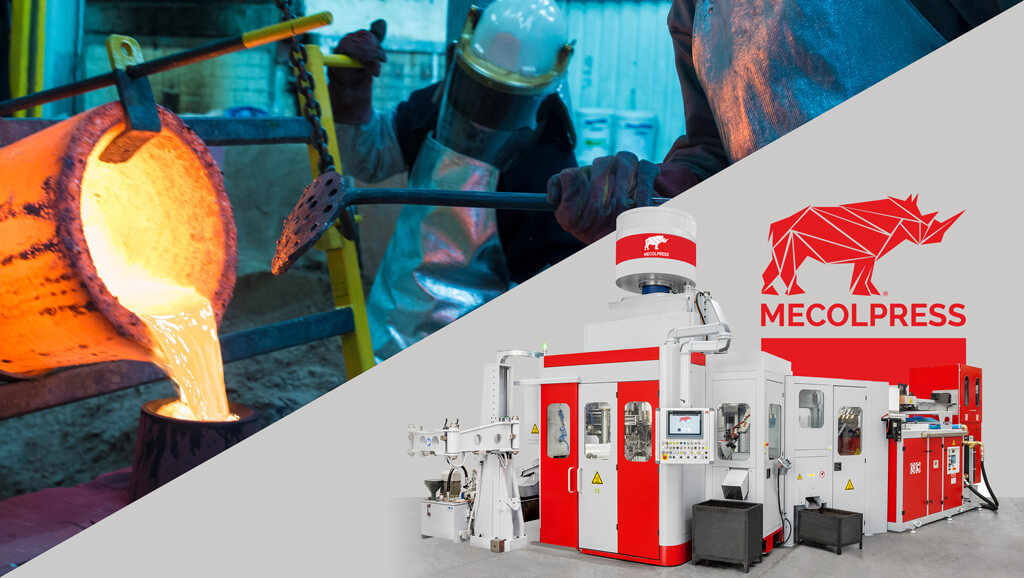
FORGING VS. METAL CASTING: WHICH TECHNOLOGY TO CHOOSE?
Forging vs. casting metals represents one of the most critical decisions in the production of metal parts, both ferrous and non-ferrous.
Casting and forging, even though they have the same goal—to obtain a part with the defined shape and characteristics—are based on completely different principles, which can influence:
- mechanical properties
- structural quality
- energy consumption
- production costs
- application areas
But which technology is best suited to your production needs?
Metal casting technology: characteristics and limitations
Casting involves bringing metal to a liquid state and pouring it into a die that reproduces the desired shape. Once solidified, the material assumes the geometry of the die.
Advantages
- High geometric flexibility
- Possibility to create very complex shapes
- Presence of internal cavities that are difficult to achieve with other technologies
- No particular dimensional limits
Structural limitations
Cast components may have internal defects such as:
- porosity
- blowholes
- segregations
These phenomena can reduce the mechanical strength and stiffness of the part, making casting less suitable for applications subject to high dynamic loads or critical structural requirements.
Forging technology: performance and reliability
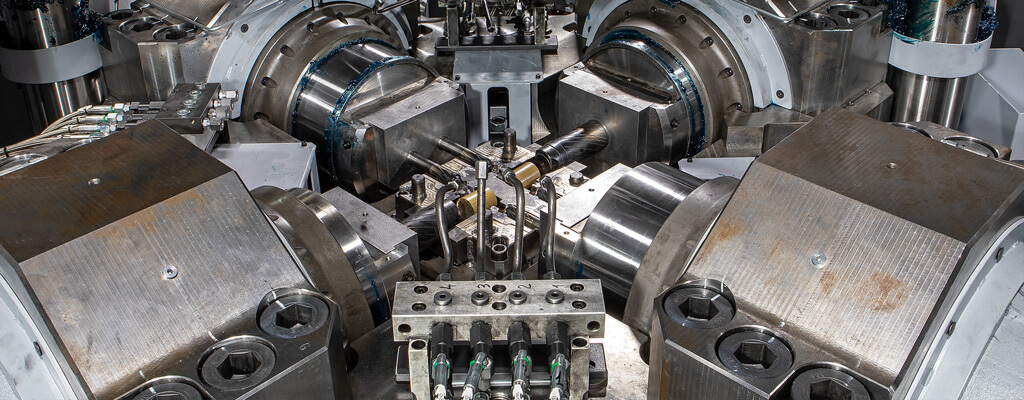
Forging is a process of plastic deformation of metal in the solid state (heated but not molten), achieved through the application of high compressive forces.
During the process:
- the internal structure of the material becomes more compact
- the fibers orient themselves according to the geometry of the piece
- internal discontinuities are drastically reduced
Forging advantages
The result is a component with:
- greater mechanical strength
- improved ductility
- high reliability over time
- more homogeneous structure
The geometric limits of forging: overcome with Mecolpress technology
Traditionally, forging can present more stringent geometric constraints than casting.
Thanks to the solutions developed by Mecolpress, these barriers can now be largely overcome.
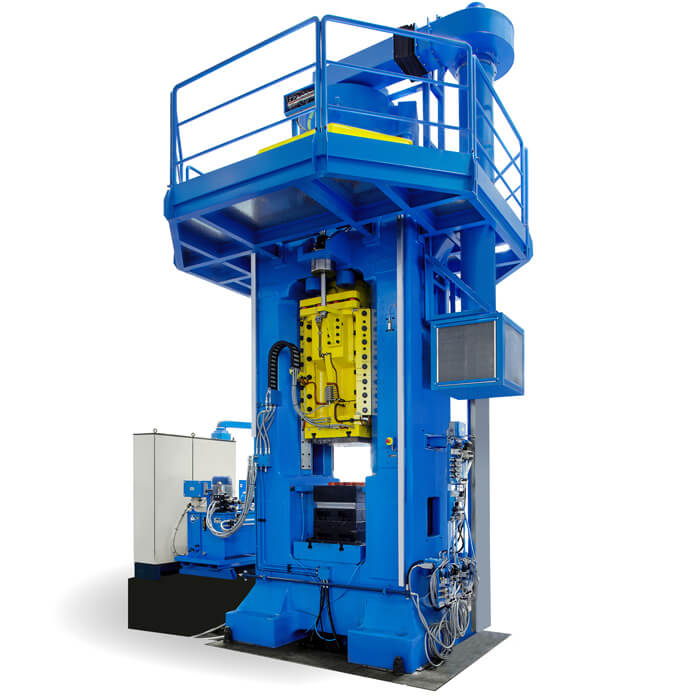
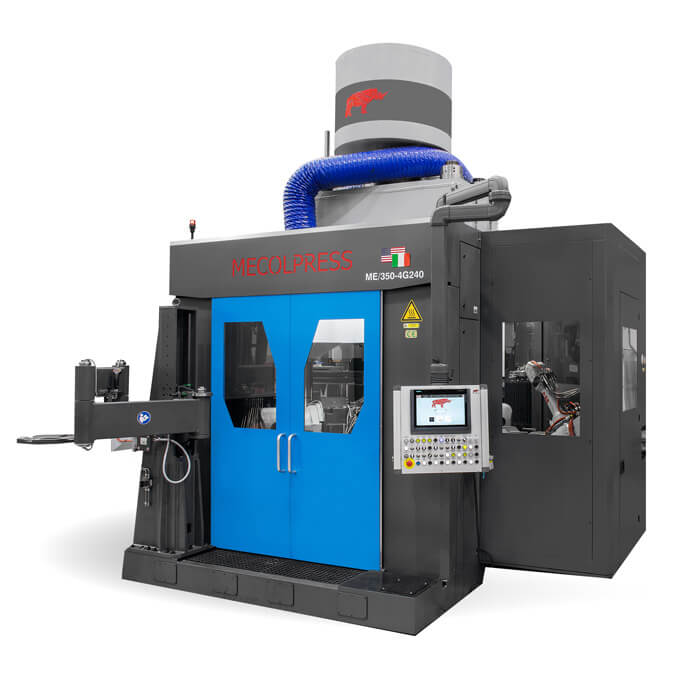
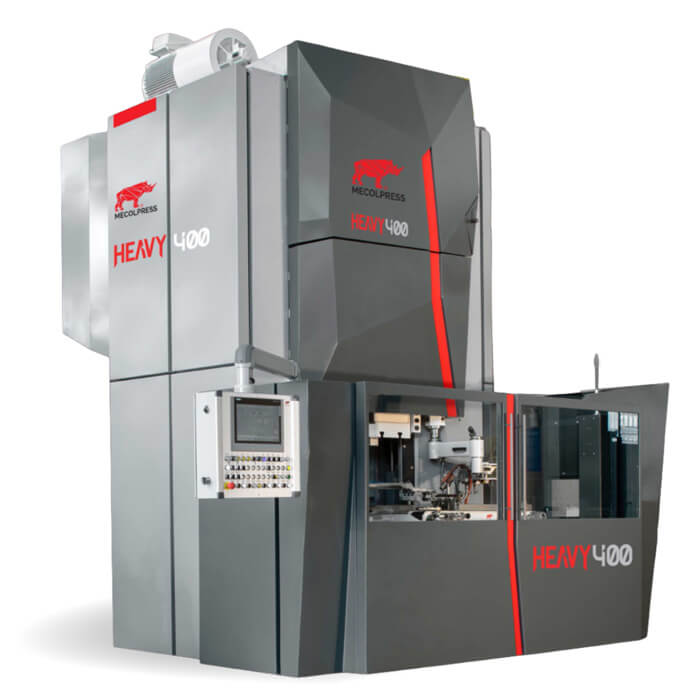
Mecolpress presses series
Advanced applications
With Mecolpress technologies it is possible to obtain:
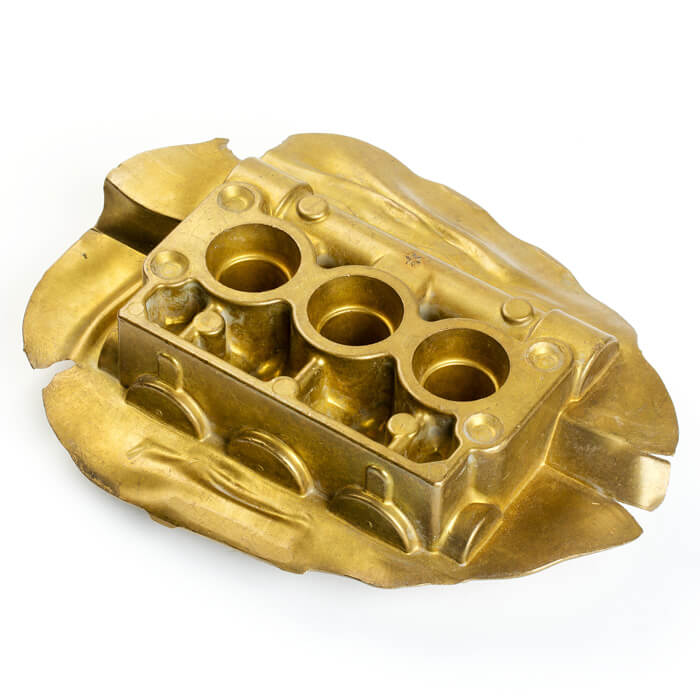
- Forging of brass components weighing more than 5 kg.
- Forging of brass and aluminium with up to 5 punches (4 horizontal + 1 vertical), even independent, up to 240 tons, to preform the piece with the minimum possible weight.
- Flash-free forging, with reduction of the material used, heating energy and subsequent processing.
- Forging of steel, aluminium, titanium and special alloys with deformation force up to 5,000 tons (TDS series).
The result is a more efficient, sustainable and cost-optimized process.
Casting vs Forging: direct comparison
| CHARACTERISTIC | CASTING | FORGING |
|---|---|---|
| State of the metal | Liquid (molten metal) More energy required More emissions | Solid or heated (not molten) Less energy required Reduction of emissions |
| Complexity of shapes | Very high Possible internal cavities | High thanks to the possibility of applying up to 5 independent punches for pre-forming |
| Mechanical properties | Lower Possible presence of defects | Elevate Compact and oriented structure |
| Typical defects | Porosity Blowing Segregations | Minor More homogeneous material |
| Mechanical resistance | Medium | High |
| Setup costs | Generally contained | Reduced thanks to the quick die changing system proposed by Mecolpress |
| Subsequent processing | Often necessary | Improved surface quality Preforming of holes thanks to punches |
| Production of big part | Yes | Limited |
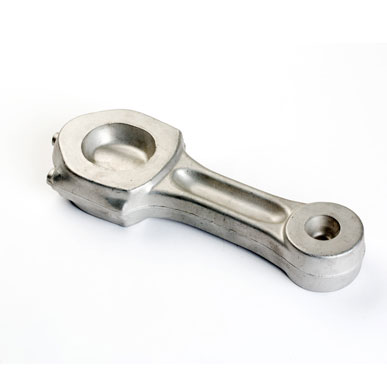
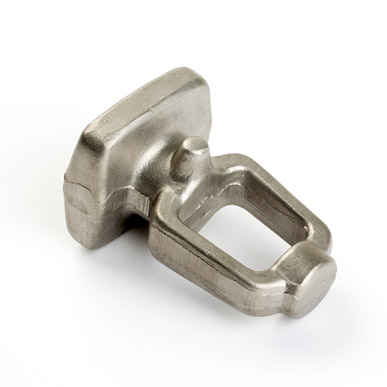
| Typical applications | Base Carter Complex components | Shafts Connecting rods Structural components for aeronautical applications Safety components Valves Medical components Fashion components |
Why choose Mecolpress forging?
In addition to the evident advantages of the forging process, Mecolpress presses integrate advanced technologies that further increase production performance.
Proprietary software that monitors and tracks all production parameters in real time, ensuring consistent quality and traceability.
- Quick dies changing system
Dies changes can be made in less than 30 minutes, without manual intervention or external equipment.
- Reduction of electricity consumption
Up to 50% less than traditional solutions, thanks to highly energy-efficient technologies.
- Teleservice
Remote access to press parameters for diagnosis, optimization, and immediate technical support.
Conclusion
The choice between casting and forging always depends on the final application of the component.
However, when the following are required:
- high mechanical properties
- structural reliability
- defect reduction
- energy efficiency
- process sustainability
Forging represents the most technologically advanced solution today.
Thanks to Mecolpress innovations, forging is increasingly overcoming traditional limitations, offering superior performance compared to casting in numerous industrial applications.
Want to learn more about which technology is best suited to your production process?
The Mecolpress team is available for a personalized technical analysis.
📩 Contact us through our website www.mecolpress.com
Metals hot forging process
Metals forging: hot or cold forging?
The forging by means of presses of metals commonly used for the industrial production, such as aluminum and brass, can happen in two ways.
- The first one is the cold coining, carried out, for example, on a piece that already has its own shape and that is forged through the press in such a way to calibrate it and to compact it. The cold coining is suitable, above all, for small size parts and for great production batches, such as screws. The most suitable machines for this type of process are our screw presses.
- The metals hot forging is different from the cold one because it allows to obtain high quality pieces by means of an important deformation of the starting material. With the deformation of brass, copper, aluminum by means of hot forging presses it is possible, indeed, to produce particular shapes, having very complicated structures as well. In order to achieve this forging, Mecolpress proposes, beyond the already mentioned screw presses, also the mechanical and hydraulic presses according to the different production necessities expressed by the customer.
Mechanical and hydraulic presses for the hot forging
The mechanical press can hot forge even complicated pieces. At the end of the process, the forged parts can often have some remaining flash that can be eliminated by means of a trimming machine, machinery that is part of the products range that we offer. The eccentric mechanical press with continuous cycle is recommended for the customers who have high production necessities, while the hydraulic press is more advisable for parts having very complicated shapes and that would require, otherwise, the usage of a lot of material. This type of press permits, indeed, a saving of the input material, so offering to the forger a good margin on the product cost. Moreover, by forging the parts by means of hydraulic hot forging presses, at the end of the productive cycle the parts range that can be produced without flash is much wider, thanks to a progressive and programmable application of the forces. Another characteristic of this type of presses is the flexibility, given by the wide number of available functions.
Hot forging line
For the metals forging a furnace that can be electric (induction) or gas furnace and a press are needed. This is the base productive line for the aluminum, brass, titanium and steel processing; line that can be upstream completed with a sawing machine that cuts the metal bar in billets and with a graphitizing machine, where the billets are treated with the graphite before these are inserted in the furnace, so that these absorb better the heat and that are kept lubricated. The graphitizing, that offers remarkable advantages from a productive point of view, such as a minor gas consumption in the furnace and a superior durability of the dies, is just fitting for some specific production typologies. It is not recommended, for example, for the production of parts that once forged, must be chrome plated or exposed to further particular treatments. Our sales department is at the disposal of our customers for suggesting the best forging line composition according to the product and to application field.
Hot forged metals
The customer’s choice for a specific press for his own productive cycle is based on the material typology used by the forger and on the shapes to achieve.
For the brass forging the hydraulic press is more fitting than the screw press, that is better for the forging of titanium and steel. The eccentric mechanical presses are used for all the metals, even for the copper hot forging. Our sales department is at disposal of our customers for offering the best technical solution for every specific productive situation.
For further information about hot forging machineries, please write us at sales@mecolpress.com